

A structured playbook: each step has a type and an instruction.
Step types
Ask — collect something from the caller
Ask — collect something from the caller
The procedure waits here until it has an answer.
Collect is the field that earns its keep. Describe what people actually
say:
Tell — say something in the assistant's own words
Tell — say something in the assistant's own words
Give it the point to make and it phrases it, in the caller’s language and in
keeping with the conversation so far.Use this for most of what the assistant says.
Say — speak exact words
Say — speak exact words
What you type is what’s said, word for word.Use it for legal wording and for confirmations that must not be paraphrased.
Remember it’s spoken in the language you wrote it, so a German caller hears
English if that’s what you typed.
Tool — use one of your tools
Tool — use one of your tools
If / else — take a different path
If / else — take a different path
Give each branch a condition in plain language. The first one that matches
runs, then the procedure rejoins the main list.Branches can nest up to three deep.
Sub-playbook — run another procedure
Sub-playbook — run another procedure
Runs another playbook, then carries on from the next step. Good for an
identity check you need at the start of several procedures.Like a tool step, it can retry and has a fallback when the child doesn’t
finish. Playbooks can nest three deep.
System — end the call or send keypad tones
System — end the call or send keypad tones
Two actions: end the call, or send DTMF digits (for navigating a menu on
another system).
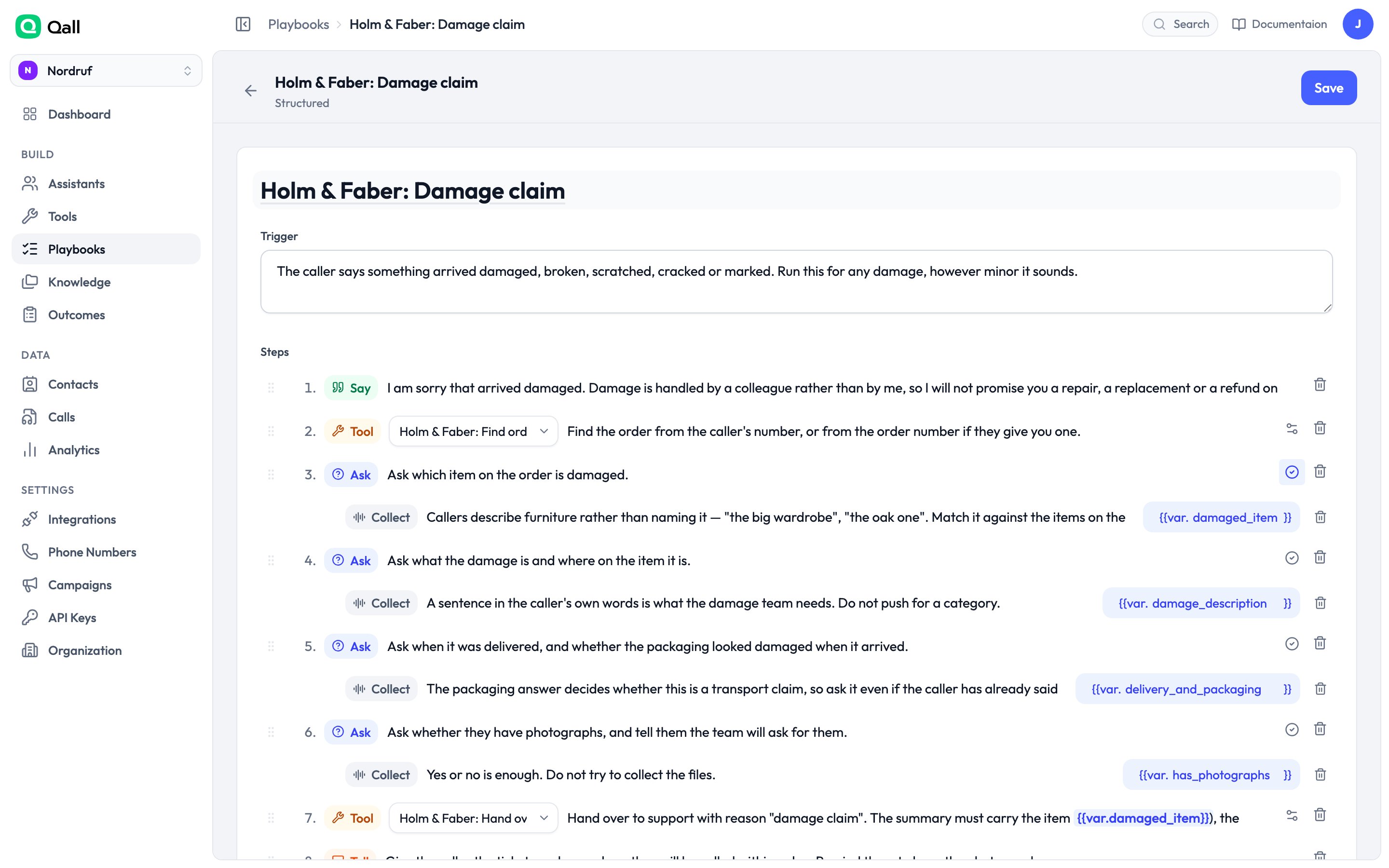
A worked example
Taking a damage claim, from the demo workspace:
Notice step 1. The expectation is set before anything is collected, so the caller
isn’t waiting for an answer the assistant was never going to give.
Writing good steps
Set expectations early. If the procedure can’t resolve the caller’s problem, say so in the first step. One thing per Ask. “What’s damaged and when did it arrive” gets you half an answer twice. Use Collect, not a format rule. People say “O R D four four one seven” and “the fourteenth of March”. Describing what you’ll hear works; demanding a format gets you a caller repeating themselves. Say for the words that matter, Tell for the rest. Over-using Say makes the assistant sound like a recording. Keep it short. If a procedure needs twenty steps, there are probably two procedures.Limits
A playbook has no time limit of its own. The call bounds it — a caller who hangs
up ends it, and one who goes quiet trips the assistant’s
idle timeout.